
Search Beyond What Can Be Taught: Evolving the Knowledge Boundary in Agentic Visual Generation




Abstract
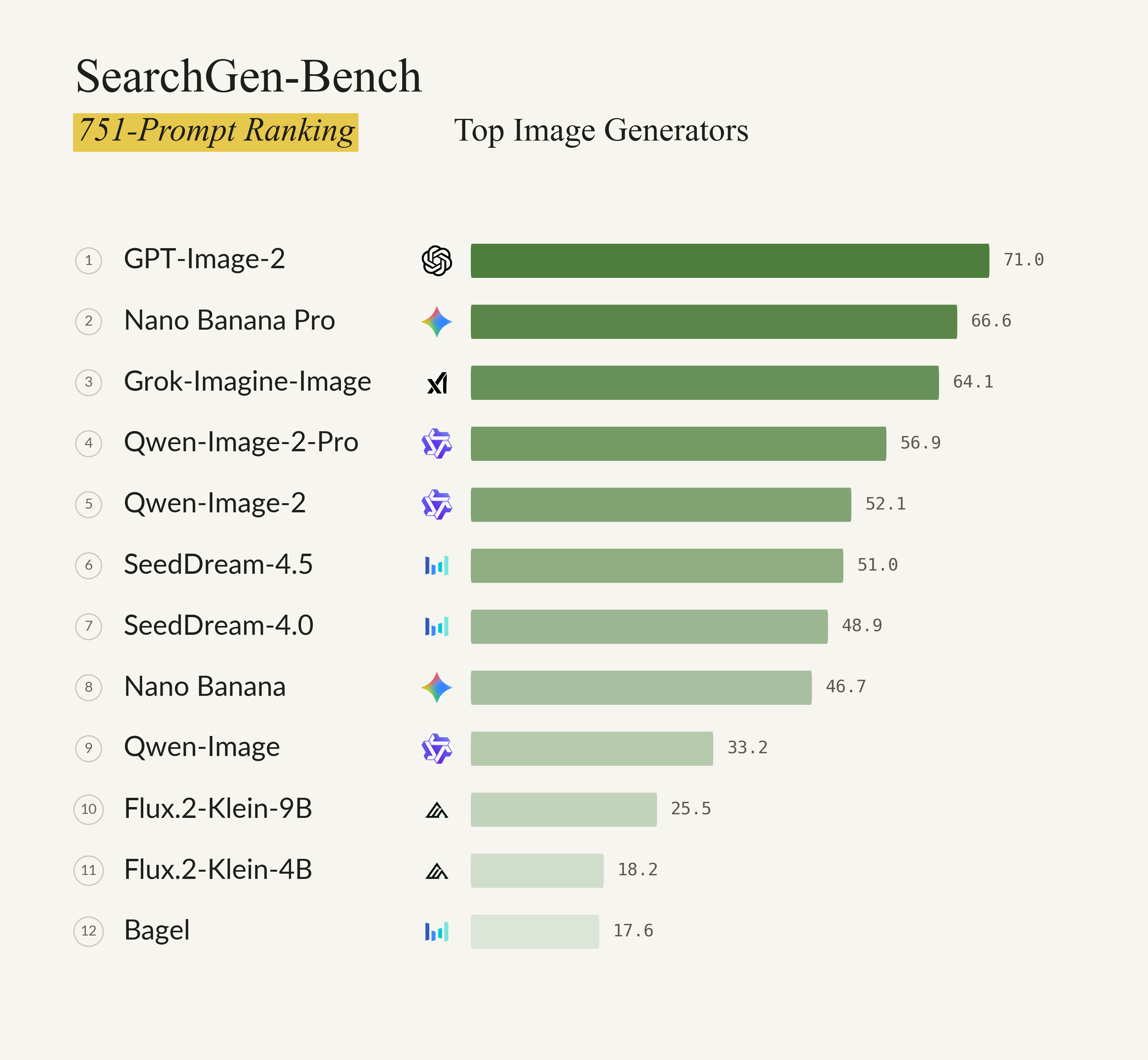
Visual generators excel at rendering, but they confidently fabricate what they do not know. User requests are unbounded, evolving, and deeply long-tailed: new characters, trending entities, post-cutoff events, and more. This world-knowledge bottleneck is structural: generators are trained on fixed corpora, but the visual world is open-ended. We construct SearchGen-20K and SearchGen-Bench, with 20,839 prompts spanning twelve failure categories and twenty-two domains, paired with a pre-executed multimodal SearchGen-Corpus-1M to support offline, reproducible research. On SearchGen-Bench, frontier open generators score only 21 to 28 out of 100, a 40-point collapse invisible to existing benchmarks. The natural remedy is to employ search tools, enabling agentic visual generation. However, we find that naive search fails: it retrieves indiscriminately, injecting noise into prompts the generator already handles. We trace the root cause to a generator-specific, evolving knowledge boundary: the divide between what a generator can internalize through training and what must remain in external context. Although this boundary is hard to specify in advance, we show that it is discoverable through a teach-then-search co-training framework. Even a minimal version of this co-training recipe produces monotonic improvement, laying the foundation for recursive self-improvement in visual generation that can meet world-knowledge-grounded requests. We release the full dataset, co-training corpus, and search corpus as a replayable harness for tool-augmented, world-knowledge-grounded visual generation.
Community
We introduce SearchGen, a search-augmented image generation framework. We argue that, rather than merely rewriting prompts, an LLM agent should actively search for and organize multimodal context to help the generator produce more accurate and informed images. We provide a live demo, a simple yet challenging benchmark that evaluates whether AI agents can find information useful for generation, a reproducible local search corpus, and the complete training dataset.



This is an automated message from the Librarian Bot. I found the following papers similar to this paper.
The following papers were recommended by the Semantic Scholar API
- MemoGen: Can Past Experience Improve Future Text-to-Image Generation? (2026)
- GenEvolve: Self-Evolving Image Generation Agents via Tool-Orchestrated Visual Experience Distillation (2026)
- RECIPE: Procedural Planning via Grounding in Instructional Video (2026)
- Do Vision-Language Models See or Guess? Measuring and Reducing Textual-Prior Reliance with a Phrasing-Controlled Benchmark (2026)
- Qwen-Image-Agent: Bridging the Context Gap in Real-World Image Generation (2026)
- CV-Arena: An Open Benchmark for Instructional Computer Vision Problem Solving with Human-AI Collaborative Preferences (2026)
- Qwen-Image-Bench: From Generation to Creation in Text-to-Image Evaluation (2026)
Please give a thumbs up to this comment if you found it helpful!
If you want recommendations for any Paper on Hugging Face checkout this Space
You can directly ask Librarian Bot for paper recommendations by tagging it in a comment: @librarian-bot recommend




Get this paper in your agent:
hf papers read 2607.05382 Don't have the latest CLI?
curl -LsSf https://hf.co/cli/install.sh | bash Models citing this paper 0
No model linking this paper